Oh boy, am I ever a child of the 1980s. I also apparently share a birthday with Dolly Parton. Huh.

Showing posts with label music. Show all posts
Showing posts with label music. Show all posts
Wednesday, January 19, 2011
Birthday Song
It's true. Today is my birthday. I used this nifty Billboard #1 song finder to discover what was the top song on the day I was born. Here it is.

Wednesday, November 24, 2010
Kid Rock To Perform NFL Halftime Show on Thanksgiving
 (Flickr/familymwr)
I have some bad news: Tomorrow, Kid Rock — that’s right, the man who made it big with Devil Without a Cause (1998) and Cocky (2001) and offered genius lyrical stylings such as “Bawitdaba da bang a dang diggy diggy diggy said the boogy said up jump the boogy” — will be performing the halftime show for one of the Thanksgiving day football games.
In some ways it makes perfect sense. After all, Rock, born Robert James Ritchie, is from the exurbs of Detroit and he’ll be performing at tomorrow’s game is between the Detroit Lions and the New England Patriots. He’s promoting his recently released album Born Free. The occasion will also promote Rock’s upcoming 40th birthday party, which will be performed at Detroit’s Fox Theatre on Comedy Central on January 17. What’s more, the NFL is no stranger to promoting itself through country stars — Faith Hill and Hank Williams, Jr., have a near-permanent place promoting the Sunday and Monday night games.
Rock has been more on the national radar lately because he also performed at Jon Stewart and Stephen Colbert’s “Rally to Restore Sanity/Keep Fear Alive” — something that could have alienated his more conservative country fans since the rally was set up in opposition to Glenn Beck’s “Rally to Restore Honor.” Rock performed with Sheryl Crow, reminding us of that other time the two had a hit (“Picture” went gold).
But the song he performed at the Stewart/Colbert rally, “Care,” had lyrics “I can’t stop the war, shelter homeless, feed the poor … I can’t change the world and make things fair / The least that I can do is care” that also pissed off some on the left. Rock’s message promoted a rather unenlightened vision — a feeling that things are bad but ultimately that nothing can be done about them.
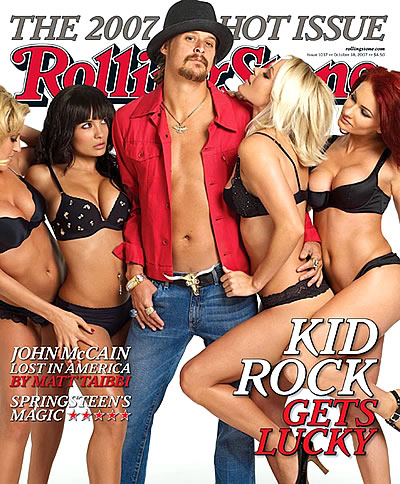
Rock came to fame in the late-1990s era of popular country, with elements of rap added into the mix. He had a reputation as a bad boy — he married and divorced Playboy model Pamela Anderson in the space of four months. His Rolling Stone covers (1 & 2) portrayed him as something of a white trash phenomenon. (One cover actually teased the story about him with the words “Kid Rock Talks Trash.”) Rock’s lyrics, however, lack some of the legitimacy of those who are actually viewed as rebelling against authority and instead promote a frustrated apathy. “Only God Knows Why,” one of his singles from his 1998 album Devil Without a Cause, presents a character trapped by circumstances and crying out in hopelessness. Even the title of the album suggests rebelling for the sake of rebelling.

The same is reflected in Rock’s lyrics to the single from his latest album. “Born Free” is a mix of anxiety and nostalgia that’s all too often reflected in modern political dialogue, “You can knock me down and watch me bleed / But you can’t keep no chains on me.” In the music video, freedom is represented by Rock driving down the highway in a convertible with longhorns on the grill. His messages are frustrated but unspecific about causes or a path forward.
Sure, we might be in the middle of a ’90s revival, but Rock’s message, something that comes neither from the left or the right, is one that I’m not really interested in revisiting. Here’s hoping we won’t see a Kid Rock comeback.
Monday, October 20, 2008
Steal This Blog Post
Randall Munroe, author of xkcd, said it best when he railed against the music industry’s effort to stem illegal downloading.

A new study conducted by Campus Computing Project, an organization that studies students’ use of Internet technology, shows that the mandates put on colleges and universities to stem illegal downloading (like those recently folded into the Higher Education Act reauthorization) are costing the institutions tens of thousands of dollars on average. Congress isn’t setting aside special subsidies for enforcement, so the old “unfunded mandate” adage comes to mind.
Why are we forcing universities to sink thousands of tuition dollars into protecting an industry that isn’t ready to admit it has an outdated model?
Some sellers, like iTunes and eMusic, have gone to great lengths to create a popular model that people are willing to buy into. But the problem is, as the comic above shows, they’re also going to great lengths to sell a protected format that is actually an inferior product. Many consumers reason that even though it is illegal, the product they can get for free is far superior to the one they pay to download. Rather than enforcing all this ridiculous legislation in an attempt to keep the record industry alive, we should just cut the lines and let them figure it out. Seriously, it’s sink or swim time for them.
Cross posted at Pushback.
Monday, April 14, 2008
The New Protest Music
Via C&L. Marc McDonald over at Beggars Can Be Choosers laments the lack of "protest music" in today's popular music landscape. I'm sure people who are far more into the music scene could bring up more specific examples than I could, but I'd have to say that McDonald presents an argument that's wrong for a couple of reasons. There argument McDonald makes is once centered on stereotypes about class and race. He compares Paris Hilton and the Dixie Chicks with Bob Dylan, these are both imperfect comparisons.
Firstly he cites Bob Dylan as a leader in the late 1960s protest music. Dylan is an interesting example, because while his lyrics can be widely interpreted as against the Vietnam War, Dylan himself (as I saw in the PBS mini-series No Direction Home) came off as rather apolitical. He wasn't into protesting and more or less blew off his co-performer and activist Joan Baez when she encouraged him to take part in war protests.
Secondly, there are two reasons why today's music isn't reflective of the war in the same way the late '60s and early '70s was. First of all, most popular singers and songwriters are largely unaffected by the war. The draft was active back in the days that McDonald talks about. Musical performers were just as much at risk as everyone else to getting drafted to fight in the war. Remember that even Elvis served a tour in Korea. Today, there are two different kinds of people serving in Iraq and Afghanistan, military contractors that are rewarded handsomely for their work, and the enlisted men and women that by and large come from lower-class, small-town America. That isn't to say these people aren't musically inclined, but when you're talking about corporate popular music, you tend to be talking about the wealthy.
But I'd argue that there is music that could be called protest music -- it just doesn't fit into the neat anti-war mold that McDonald outlines. Anyone who's seen Gunner Palace has heard some of the rhymes and heavy metal lyrics soldiers are composing that indicate exactly how fucked up the war in Iraq is. Obviously McDonald's never heard of the Hip Hop Caucus, and other black artists like M-1 who actively speak up against the war. Furthermore, some of the hip hop out there has been talking about the street wars for years. Sure, maybe when you look at the largely white, upper crust of the Billboard charts you may not see a lot of "protest music," but when you look closer, music about the war does exist.
Cross posted.
Firstly he cites Bob Dylan as a leader in the late 1960s protest music. Dylan is an interesting example, because while his lyrics can be widely interpreted as against the Vietnam War, Dylan himself (as I saw in the PBS mini-series No Direction Home) came off as rather apolitical. He wasn't into protesting and more or less blew off his co-performer and activist Joan Baez when she encouraged him to take part in war protests.
Secondly, there are two reasons why today's music isn't reflective of the war in the same way the late '60s and early '70s was. First of all, most popular singers and songwriters are largely unaffected by the war. The draft was active back in the days that McDonald talks about. Musical performers were just as much at risk as everyone else to getting drafted to fight in the war. Remember that even Elvis served a tour in Korea. Today, there are two different kinds of people serving in Iraq and Afghanistan, military contractors that are rewarded handsomely for their work, and the enlisted men and women that by and large come from lower-class, small-town America. That isn't to say these people aren't musically inclined, but when you're talking about corporate popular music, you tend to be talking about the wealthy.
But I'd argue that there is music that could be called protest music -- it just doesn't fit into the neat anti-war mold that McDonald outlines. Anyone who's seen Gunner Palace has heard some of the rhymes and heavy metal lyrics soldiers are composing that indicate exactly how fucked up the war in Iraq is. Obviously McDonald's never heard of the Hip Hop Caucus, and other black artists like M-1 who actively speak up against the war. Furthermore, some of the hip hop out there has been talking about the street wars for years. Sure, maybe when you look at the largely white, upper crust of the Billboard charts you may not see a lot of "protest music," but when you look closer, music about the war does exist.
Cross posted.
Tuesday, September 4, 2007
Too Late to Save the Record Industry
The NYTimes Magazine had a profile of Rick Rubin this weekend, the man anointed by Columbia Records to save the industry. It's no secret that the record industry has been languishing in the last few years. So what's the new strategy?
"Everything I do," Rubin told me earlier, "whether it's producing, or signing an artist, always starts with the songs. When I'm listening, I'm looking for a balance that you could see in anything. Whether it's a great painting or a building or a sunset. There's just a natural human element to a great song that feels immediately satisfying. I like the song to create a mood."
So the record industry will save itself by--drumroll, please--listening to music. Brilliant. They're also not going to make Rubin punch a clock or have a desk. This is supposed to be a revolutionary tactic?
What the record industry doesn't seem to get is that the future of music has already passed them by. People don't want big record executive dictating what will be popular. They want to figure it out for themselves. This is why, for better or worse, things like Pitchfork are so popular. In the age of digital sharing, it's far better for bands just to have their music heard than to get signed with a label.It seems that the record industry wants ownership over the intellectual product of music, even if it's not in the best interest of the creator. Rubin talked of a way the industry screwed up with Neil Diamond:
"The CD debuted at No. 4," Rubin told me at Hugo's, still sounding upset. "It was the highest debut of Neil's career, off to a great start. But Columbia — it was some kind of corporate thing — had put spyware on the CD. That kept people from copying it, but it also somehow recorded information about whoever bought the record.The spyware became public knowledge, and people freaked out. There were some lawsuits filed, and the CD was recalled by Columbia. Literally pulled from stores. We came out on a Tuesday, by the following week the CD was not available. Columbia released it again in a month, but we never recovered. Neil was furious, and I vowed never to make another album with Columbia."
It doesn't seem that they're getting it right. What they don't seem to get is that the advantage to creativity is that it inspires others. By letting go a little on protections, we can create a richer culture.
Subscribe to:
Posts (Atom)
