Tuesday, September 9, 2008

Charging for Rape Kits in Wasilla, Alaska

Via Mike Tomasky, apparently during Sarah Palin’s reign as mayor of Wasilla the hospital had a policy of charging victims for rape kits:

While the Alaska State Troopers and most municipal police agencies have covered the cost of exams, which cost between $300 to $1,200 apiece, the Wasilla police department does charge the victims of sexual assault for the tests.

The thing is this is actually a fairly common practice around the country and doesn’t really have anything to do with Sarah Palin or Wasilla. This is a real problem in this country. Yes, it’s linked to the fact that people have to pay for medical care in this country whether they can afford it or not. But the fact of the matter is, if you are a rape victim, that event will cost you. It will cost you in medical bills, therapy, and legal fees if you choose to press charges. This shouldn’t be the policy in Wasilla and it shouldn’t be the policy anywhere in this country.

Cross posted at Pushback.

Monday, September 8, 2008

Michelle Obama is Fabulous


The Burgeoning Education Reform Movement on the Left

This Sunday’s New York Times Magazine had an article by Paul Tough on the division between teachers’ unions and education reformers. It seems that President Bush’s No Child Left Behind law, while problematic, is shining light on some pretty significant achievement gap that falls along racial lines.

As Dana Goldstein reported in a piece on an education reform event at the Democratic National Convention:

In the United States, about half of all black and Latino students drop out of high school, while 78 percent of white students earn a degree. And while No Child Left Behind is regarded as deeply flawed legislation in every quarter, it is also almost uniformly praised by policy wonks for shining a light on the achievement gap and for instituting the first national collection of education data correlated by race and family income.

Tough pointed out that there “is evidence that schools can do a lot to erase that divide, but the reality is that most schools do not. If we truly want to counter the effects of poverty on the achievement of children, these advocates argue, we need to start a whole lot earlier and do a whole lot more.”

But while education reformers love to paint teachers unions as standing in the way of real reform, Kevin Carey’s piece (sub. req.) in latest issue of The American Prospect notes that while teachers’ unions tend to be resistant to change, the reasons are more structural than attitudinal:

[A]s unions’ ability to garner pay increases has slowed since the 1970s, their agenda became more focused on two key goals: job security and classroom autonomy. Unions also focused on school security, seeking to maintain the status quo. They weren’t interested in letting other public schools compete for the same children or letting outside agencies judge school results. Classroom autonomy, meanwhile, was seen as a key element of elevating the teaching profession into the realm of respected, self-directed professionals. This, too, argued against uniform standards. [emphasis his]

So the answer, it seems, lies somewhere in the middle. Rather than the left’s old solution of “throwing money at the problem,” there does seem to be a need for achievement standards. That way, at least, there are measurable ways to see which students are lagging behind. Then educators can begin to look at why. But there’s also a need for real investment in school infrastructure, teacher compensation, and early childhood education. It seems that both sides need to open themselves up to criticism and then work together to come to a solution.

Cross posted on pushback.

Biden on Conception


This weekend on Meet the Press, Democratic Vice Presidential nominee Joe Biden noted that he identified with the Catholic Church's definition of life beginning at conception, and the New York Times reported that fact. I do hope you watch the whole clip, because I think that this is where the real issue is. As a pro-choice person I don't dispute that some people believe that life begins at conception, even if I might disagree with them. They're entitled to believe that. But, as Biden points out, it's wrong to force that belief on others who may still have a strong faith but believe that abortion can be a moral choice.

On the flip side, Biden doesn't support federal funding of abortion. While this seems like a principled stance, I think that people often forget that taking away federally funding for abortion often leaves poor women, sometimes the women who didn't get proper sex education, without options. If you can't afford an abortion and there isn't some kind of assistance, federal or otherwise, to help you have all your options available, then you no longer have that choice.

Friday, September 5, 2008

Orders to the Alaska National Guard Not from Sarah Palin

When Republicans introduced Sarah Palin to the audience at the RNC, they touted her executive experience -- something no one else seems to have. To show how capable she was to lead, they said that she is commander-in-chief of the Alaska National Guard.

But a recent McClatchy report shows that Palin never issued any orders to the National Guard in her state. As long as troops are called up for federal service, Palin has no authority over the troops. Her authority over the state's National Guard extends to in-state national disasters and emergencies. In the two years that she has been governor, Palin hasn't commanded the troops in such an instance. So I guess her executive experience commanding troops is a bit oversold.

Thursday, September 4, 2008

Investing in 'Clean Coal' a Misstep By Both Candidates

Last week, Barack Obama promised to tackle the problem of global warming in his acceptance speech in Denver:
As president, as president, I will tap our natural gas reserves, invest in clean coal technology , and find ways to safely harness nuclear power. I'll help our auto companies re-tool, so that the fuel-efficient cars of the future are built right here in America.

And tonight, John McCain also promised to tackle the issue during his own acceptance speech in St. Paul:
We will produce more energy at home. We will drill new wells offshore, and we'll drill them now. We will build more nuclear power plants. We will develop clean coal technology . We will increase the use of wind, tide, solar and natural gas. We will encourage the development and use of flex fuel, hybrid and electric automobiles.

But as Rob pointed out earlier this week, clean coal is still pretty bad , and won't be any real solution to global warming or be better environmental policy in the long term.

Cross posted at Pushback.

"Radical Moderates" in Minnesota

Progressive Republicans
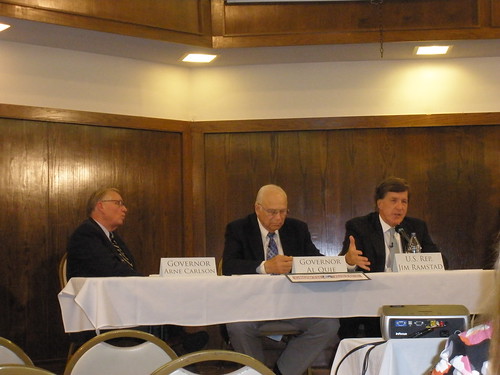
Yesterday morning I went to an event sponsored by Growth and Justice, a think tank in Minnesota that takes a more moderate pro-business view than other conservative groups. The event highlighted former Minnesota Governors Al Quie and Arnie Carlson, as well as retiring Congressman Jim Ramstead. The idea was to highlight how these were Republicans who were committed to social justice as well as promoting business growth.

The group's president, Dane Smith, opened the event by saying, "It's good to see so many fire-breathing radical moderates in one room." He noted that Minnesota was among the top ten states in economic growth at the same time it was one of the top ten most heavily taxed states--that is, "until recently." He talked of the state's tradition in investing in education and health care. Of the speakers, many are known for being moderate Republicans, and each has a crowning social justice achievement.

Ramstead has co-sponsored the Mental Health and Addiction Equity Act, something that Paul Wellstone pushed for during his time in the Senate. Ramstead said he expects the bill to be passed and signed into law this September.

Quie inherited a budget crisis while governor, and is often hailed for his fiscal responsibility. Lately, he has devoted himself to social justice causes such as the prison crisis and education for children with disabilities.

Much like Quie, Arnie Carlson's role as governor was highlighted by tackling a budgetary crisis. He established what's now known as Minnesota Care, a program that provides health insurance to low-income families. He also pushed for the anti-discrimination laws in Minnesota to include gays and lesbians--a move so controversial that Republicans didn't endorse him for his re-election campaign in 1994, when he won the majority of the vote, something that hasn't happened in a gubernatorial election since.

The significant thing about this event is that the moderate Republicans on the panel criticized the "no new taxes" and caps on tax increases that have been common with conservatives in recent years. These moderates favored a balanced budget and social programs for the poor over voting "no" on tax increases at every opportunity. Smith pointed out that in 2006, during Governor Tim Pawlenty's re-election campaign, 200 of Minnesota's wealthiest individuals took out a full-page ad in Star Tribune to declare that they could afford to pay more in taxes.

But looking around the room of "radical moderates," many of them fell on the later side of life. Fewer than half a dozen people in the room were under 30, and of those many were reporters or staffing the event. Whether that means that young people today are more extreme than in the past or that moderates are having a harder time reaching out to young people it's hard to say. But it's interesting how such moderate voices are rarely reflected in the political debate today.

Cross posted at Pushback.

Related Posts Plugin for WordPress, Blogger...