Showing posts with label politics. Show all posts

Monday, January 10, 2011

On the Shooting of Rep. Gabrielle Giffords and Violent Political Rhetoric

(Flickr/kevin.asher)

As the country tries to digest the violent shooting of Rep. Gabrielle Giffords (D-Ariz.) that left six dead and 14 others wounded, the language around political discourse has come under scrutiny. Giffords is believed to be the first female American politician that has undergone an assassination attempt. Giffords is still in critical condition as of this writing.

Victims in the shooting included Judge John Roll, a 63-year-old state appeals court judge who had recently received death threats for a ruling that found ranchers holding people at gunpoint upon crossing the boarder were acting illegally, and Christina-Taylor Green, a 9-year-old girl who was born on 9/11 and already showed promise as a potential leader since she was recently elected president of her class. The alleged shooter, Jared L. Loughner, is in custody and faces federal charges for an assassination attempt.

Shortly after news of the shooting broke, material from Sarah Palin's PAC revealed Giffords had been one of the electoral "targets," and the campaign materials used gun sights as imagery. Jessica Valenti published a piece in The Guardian that notes that Palin's PAC may have used such imagery thanks to a surge of "man up" rhetoric in politics recently:
In a country that sees masculinity – especially violent masculinity – as the ideal, it's no wonder that this type of language resonates. But it's a sad state of affairs when women in politics have to resort to using the same gendered stereotypes that kept all women out of public service for so long.
Discussions following the violent shooting on Saturday left those on the right reiterating that there was no connection between violent rhetoric and the actions of one mentally ill individual (Jill did a great job of explaining why simply blaming mental illness is bad). Those on the left insisted that violent rhetoric put forth by the Tea Party and others is creating a culture that deranged individuals might tap into.

This reminds me, oddly of the debate that came after the fatal shooting of Dr. George Tiller, a late-term abortion provider in Kansas who was shot to death in his church by Scott Roeder. Many of Tiller's colleagues noted the sustained and repeated harassment they and Tiller received over the years. Tiller's name was a rallying cry for the anti-choice right. Many were shocked that those on the right claimed that their often violent rhetoric toward Tiller wasn't connected to Roeder's actions.

The causes of violence are complex. The truth is we really don't know what makes someone attempt violence of this nature on another person. I'm not ready to blame Palin or others on the right personally, especially as details of the shooting are still getting sorted out. But would it hurt to make our political rhetoric more civilized and less violent? Definitely not.

Thursday, February 11, 2010

Friday, March 20, 2009

Meghan McCain Didn't Watch the Whole Interview

So Meghan McCain Twittered this after Obama's appearance on Leno last night:

But, if Meghan McCain had actually watched the interview (I mean, I know it's 27 minutes, so it's a long one) she would have noticed that Obama did deal substantively with AIG bonuses. Now, it's up for debate whether you agree with Obama's take on the bonuses, but ultimately you can't accuse him of shying away from the issue.

Take this excerpt from the transcript:

Q Let me ask you about this. I know you are angry –- because, you know, doing what I do, you kind of study body language a little bit. And you looked very angry about these bonuses. Actually, stunned.

THE PRESIDENT: Stunned. "Stunned" is the word.

Q Tell people what happened. I know people have been over it, just –-

THE PRESIDENT: Well, look, here's what happened. You've got a company, AIG, which used to be just a regular, old insurance company. Then they insured a whole bunch of stuff and they were very profitable and it was a good, solid company.

Then they decided –- some smart person decided, let's put a hedge fund on top of the insurance company and let's sell these derivative products to banks all around the world –- which are basically guarantees or insurance policies on all these sub-prime mortgages.

And this smart person said, you know, none of these things are going to go bust; this sub-prime thing, it's a great deal, you can make a lot of profit. So they sold a whole bunch of them –- billions and billions of dollars. And what happened is, is that when people started going bust on sub-prime mortgages you had $30 worth of debt on every dollar worth of mortgage –- and the whole house of cards just started falling down.

So the problem with AIG was that it owed so much and was tangled up with so many banks and institutions that if you had allowed it to just liquidate, to go into bankruptcy, it could have brought the whole financial system down. So it was the right thing to do to intervene in AIG.

Now, the question is, who in their right mind, when your company is going bust, decides we're going to be paying a whole bunch of bonuses to people? And that, I think, speaks to a broader culture that existed on Wall Street, where I think people just had this general attitude of entitlement, where, we must be the best and the brightest, we deserve $10 million or $50 million or $100 million dollar payouts –-

Q Right.

THE PRESIDENT: And, you know, the immediate bonuses that went to AIG are a problem. But the larger problem is we've got to get back to an attitude where people know enough is enough, and people have a sense of responsibility and they understand that their actions are going to have an impact on everybody. And if we can get back to those values that built America, then I think we're going to be okay. (Applause.)

Q Well, you know, it’s interesting, when you said -– it's, like, I had to laugh the other day when the CEO of AIG said, okay, I've asked them to give half the bonuses back. Now, if you rob a bank and you go into court –- (laughter) –- and you go, Your Honor, I'm going to give you half the money back. (Laughter.) And they seem stunned that we’re not jumping at this wonderful offer.

THE PRESIDENT: Well, you know, the only place I think that might work is in Hollywood. (Laughter.)

If that's avoiding talking about the bailout bonuses, then I'd like to see what Meghan was looking for. The interview, despite the joke about "Special Olympics," was one of the most substantive things I've seen on late night TV in a while.

Tuesday, March 3, 2009

Who Takes Over for Sebelius?

Yesterday I wrote about Kansas Gov. Kathleen Sebelius for HHS Secretary. Today I just wanted to take a look at what might happen in the state if Sebelius is confirmed. The Kansas governorship is term-limited, so Sebelius would have been out after the next election anyway. But the lieutenant governor, Mark Parkinson, has a history with the Kansas Republican Party. Although he's a Democrat now and has always been pro-choice, Parkinson's history of jumping ship on the party might prove difficult for him as he becomes governor.

Former Sen. Sam Brownback, the state's most outspoken national politician on abortion issues, has pledged to run for the seat.

Thursday, February 19, 2009

Michelle Bachmann's Drivel

Michelle Bachmann did an interview last week with KLTK radio where she claimed that the stimulus was designed for Democrats to give money to "their favorite constituencies" and declared that "we're running out of rich people in this country." She said that the stimulus plan was favoring Democratic districts and circumventing Republican districts.

Well, MNPublis did a little fact check. Apparently Bachmann's district stands to benefit the most from the bill in terms of job creation. So while she runs around blaming the "community organizer in chief" for overspending at the expense of Republicans, she's benefiting from it. Well, she does say "this is serious."

Tuesday, February 17, 2009

What Is Centrism, Anyway?

Paul Waldman talks about how during the stimulus negotiations, the centrists ultimately won out. Many people pride themselves on being "somewhere in the middle," but Waldman has a harsher take on it:

So just what does it mean to be a "centrist"? To people who don't care much about politics, it may just seem like centrists are a third team between the right and the left, doing their best to advance their own interests, just as everyone else does. But if you believe political beliefs matter, and that politics is where our competing visions of the world come to fruition or are defeated, then centrism is the most cynical ideology of all, one utterly devoid of substance.

That isn't to say that one has to be a conservative or a progressive to be principled. Libertarians are among the most politically principled people you'll ever encounter, and their views don't line up neatly on the left-right axis that defines much of our politics. But unlike libertarianism -- or conservatism, or progressivism -- centrism defines itself not by fundamental principles or a particular view of the way the world works, but simply by what other people are thinking. The centrist isn't sure what he believes until you tell him what the left and the right believe. Only then does he know where he should put himself.

With all this talk about what is conservative and what is liberal, it's worth pointing out that centrism isn't really an ideology in and of itself. It's true that centrism is an ideology of relativism. It's really odd, then that someone would proudly call oneself a "centrist" when there is no coherent ideology that goes with that. In the end, the center is what is left over after the right and the left have staked out their positions. It is a remnant of an ideology, not one itself.

Uh, Where's the Diversity?

Today Al Kamen in the Washington Post writes about how Barack Obama, despite making history with by becoming the first black president, still has a fairly male, white cabinet when you look at his first picks.
Thirty-eight of the 56 appointees (68 percent) are men, (But white men, representing 46 percent of all picks, fall short of a majority.)
It's true, though, that Obama's doing better on increasing diversity than his predecessors:
By way of comparison on a few of these statistics, 39 of Bill Clinton's first 48 nominees (81 percent) were white and seven (15 percent) were African American; 75 percent were men. Of George W. Bush's 28 first nominees, 22 were white (79 percent) and only 14 percent were women, according to data compiled by the Presidential Transition Project at New York University's Wagner School of Public Service.
Still, if you were expecting Obama to be a shining beacon of diversity in the upper tiers of the government's elite, you are bound to be disappointed. This goes back to the age old "chicken and egg" diversity problem. The most common response to complaints about lack of diversity is that there just aren't women and minorities that would be considered qualified for such leadership positions. But how are we supposed to increase diversity if we never give anyone but an old, white man the opportunity to lead something?

I'm not entirely surprised that Obama's cabinet is rather homogeneous. After all, there's always the competing, counterintuitive argument that might win out. Obama, because he is black and on the younger side, "needs" older, established Washington types to build his credibility. This is problematic, to say the least. Chris Hayes did a good job of illustrating how certain Washington people keep getting recycled even if past performance has been less than stellar.

Obviously people shouldn't be appointed solely because they fulfill a diversity requirement, but all too often there are qualified people out there who would both do a fantastic job and would add necessary perspective. The government's job is to work for everyone, not just the white men.

Tuesday, February 10, 2009

Paul Waldman's Insights

I kind of love how sarcastic Paul Waldman is. This passage of his column today made me laugh out loud:
So last week we heard Michael Steele, the newly elected chairman of the Republican National Committee, declare grandly, "Let's get this notion out of our heads that the government creates jobs. Not in the history of mankind has the government ever created a job." Steele's elaboration attempted to acknowledge that there are people who do in fact work for the government, but he was nonetheless unable to claw his way back to reality: "Small business owners do, small enterprises do. Not the government. When the government contract runs out, that job goes away." As opposed to a job in the private sector, which once it is created, lives on forever, though the 598,000 people who lost their jobs last month might tell you different.
It's always so absurd to me how conservatives seem to believe that the government doesn't actually do anything. They seem to believe that trash magically disappears, drivers licenses appear out of nowhere, parks stay manicured on their own, and public schools are filled with disciplined, self-taught students. Furthermore, Republican politicians tend to think that they are employed by someone other than the government and that their staffs work from a privately subsidized budget.

It's certainly true that there are some instances of waste in the government but most of the services provided are vital to a well-functioning economy. These are the kinds of jobs that the stimulus bill is designed to create. Conservatives just seem to forget how the government works.

Friday, January 9, 2009

About Sanjay Gupta

Today over at RH Reality Check I have a piece on Sanjay Gupta, who has been floated as the probable candidate for surgeon general:

Since the Obama administration announced that CNN's Sanjay Gupta, one of People magazine's "sexiest men alive" in 2003, might be the next surgeon general, reactions have ranged from indifferent to outraged. Although Gupta is a neurosurgeon and has been in the public eye for years - he started his "House Call" show on CNN in 2004 - many have been scrambling to figure out what this man stands for.

Two separate controversies have already risen since Gupta's name has publicly been floated as the next surgeon general. First, New York Times columnist Paul Krugman lambasted Gupta's critique of Michael Moore's 2007 film Sicko, saying that Gupta's accusation that Moore "fudged the facts" was, well, just plain wrong. Then Rep. John Conyers (D-MI) wrote a letter to his fellow Democrats urging them to oppose Gupta as surgeon general. Conyers claimed that Gupta would face a "credibility problem," given his lack of experience in the National Health Service Corp and that "it is not in the best interests of the nation to have someone ... who lacks the requisite experience needed to oversee the federal agency that provides crucial health care assistance to some of the poorest and most underserved communities in America."

Many bloggers have already written about Gupta's lack of administrative experience, his opposition to marijuana reforms, and some of his biggest medical reporting mistakes. But little is known about where Gupta stands on reproductive health.
Go ahead an read the whole thing.

Wednesday, November 26, 2008

Thoughts on Daschle

While President-elect Barack Obama's transition team is busy announcing his appointments to State, Defense, and OMB, in my column at RH Reality Check this week I take a closer look at the choice of Tom Daschle as Health and Human Services Secretary. Some are pleased, others aren't:

Gloria Feldt, president and CEO of Planned Parenthood from 1994-2005, was less than excited to hear the news of Daschle's appointment. "Tom Daschle's strengths are that he is well-connected in Washington, he is well-connected in the health care industry, although some may say that there are conflicts there, he fully understands and knows the congressional process of making legislation, of policy creation, and he I think enjoys a great deal of respect from members of Congress. That said, many of those very strengths are his weaknesses as well," Feldt said. She notes that Dashle wasn't particularly known for a strong leadership style, but came to the debate as a compromiser, especially following the Democrats' electoral defeat of 2000.

In particular Feldt pointed to meetings she had with Daschle in the early days of the Bush administration about anti-choice judicial nominees. "Tom Daschle's response was to essentially roll over and play dead," she said. "His first answer was, ‘These guys are going to get confirmed anyway. Why are you asking us to fight?'"
Read the whole thing here.

Friday, November 14, 2008

HHS Update

Democratic National Committee Chairman Howard Dean won't be secretary of the Department of Health and Human Services. This is probably a good thing, not because I don't like Dean, but because his largest qualification seemed to be that he was, um, a doctor. Practicing medicine and knowing health policy are not the same, people. Not the same at all.

Monday, September 29, 2008

Sarah Palin’s Name Is a Boost for Both Sides

After the Republican National Convention, the Republican Party raked in $1 million. But an email campaign last week also helped Planned Parenthood raise more than $800,000 by mentioning Palin’s name. The effort had also been pushed out by various feminist blogs. It shows that charismatic and polarizing politicians have huge capacities for fundraising efforts on both the left and the right. Interestingly enough, the New York Times’ Caucus blog ended its post about the fundraising effort with, “Planned Parenthood said it would begin mailing the thank-you cards next week. The McCain campaign declined to comment."

Cross posted on Pushback.

Wednesday, September 24, 2008

Lifetime's Poll of Women

Too bad Mark Penn isn’t working on campaigns anymore, because I get the feeling he’d love to talk about the poll of “Lifetime moms” the women’s network just released. The poll, which certainly raises more questions than it answers, shows women pretty evenly divided between the Republican and Democratic tickets. Women voters in the poll were equally divided on the question of which candidate best represents the interests of women.

One of the many weird things about this poll is that the consensus was that they felt Sen. Hillary Clinton was treated more fairly during the campaign than Gov. Sarah Palin, with “56% saying coverage of Clinton was fair and 50% saying that coverage of Palin has been fair.” But this doesn’t seem like a fair comparison. Clinton has been in the public eye for decades. When she campaigned as a potential first lady, first in 1988 and then in 1992, she experienced some pretty harsh treatment by the media, including of her hair. Today, Sarah Palin is new to the national scene and she, too is experiencing some harsh criticism–including wouldn’t you know it, of her hair.

The one thing that we know from 2004 is that married women tend to vote very differently than single women. This is a curious trend to me. I’d like to see a breakdown of the Lifetime poll above to see how many of the 534 likely women voters they surveyed were married and if those trends reflect larger marriage trends in American society today. In the end, the Lifetime poll shows women are as divided about the election as, say, America as a whole. It just reconfirms that women aren’t a monolithic group.

Cross posted on Pushback.

Monday, September 15, 2008

Republicans Divided on Choice

In the increasing age of the ideological polarization of social issues, the Republican Majority for Choice seemed like a fresh breath of air when I interviewed one of their co-chairs at the Republican National Convention. But the RMC is perhaps a little too optimistic about the outcome of a McCain/Palin ticket:

In the end, the battle becomes about justices on the Supreme Court. Though McCain has made his judicial philosophy clear -- and essentially guaranteed the nomination of a "strict constructionist" justice or justices in the mold of Robert and Alito -- Stockman sees the Democratic Congress as a buffer to the most egregious of his possible choices: "Believe it or not, I'm not as concerned because Democrats will control the Senate and McCain can't propose [a judicial nominee] who's on the record as being anti-choice," Stockman said.

Despite RMC's optimism that McCain will prioritize other issues over women's health and rights, his track record aligns overwhelmingly with a pro-life agenda. As Sarah Blustain reported in The New Republic earlier this summer, McCain has voted against women's health and rights issues -- ranging from birth control access to abortion -- 125 out of 130 times.
Read the rest of what I wrote over at RH Reality Check.

Wednesday, September 10, 2008

Too Many Women

Awesome headline, New York Observer editors. In an intense presidential election, of course people are tiring of political stories, but it's not that people are tired of politics or the campaign season, it's because America is tired of feminism. Because, you know, we have too many women running around. And furthermore, there is just no difference between Hillary Clinton and Cindy McCain. You can lump them all into the same lady-parts category. Ugh. I'm really hating this new trend of equating Republican women like Cindy McCain and Sarah Palin with feminism.

Monday, September 8, 2008

Biden on Conception


This weekend on Meet the Press, Democratic Vice Presidential nominee Joe Biden noted that he identified with the Catholic Church's definition of life beginning at conception, and the New York Times reported that fact. I do hope you watch the whole clip, because I think that this is where the real issue is. As a pro-choice person I don't dispute that some people believe that life begins at conception, even if I might disagree with them. They're entitled to believe that. But, as Biden points out, it's wrong to force that belief on others who may still have a strong faith but believe that abortion can be a moral choice.

On the flip side, Biden doesn't support federal funding of abortion. While this seems like a principled stance, I think that people often forget that taking away federally funding for abortion often leaves poor women, sometimes the women who didn't get proper sex education, without options. If you can't afford an abortion and there isn't some kind of assistance, federal or otherwise, to help you have all your options available, then you no longer have that choice.

Thursday, September 4, 2008

Investing in 'Clean Coal' a Misstep By Both Candidates

Last week, Barack Obama promised to tackle the problem of global warming in his acceptance speech in Denver:
As president, as president, I will tap our natural gas reserves, invest in clean coal technology , and find ways to safely harness nuclear power. I'll help our auto companies re-tool, so that the fuel-efficient cars of the future are built right here in America.

And tonight, John McCain also promised to tackle the issue during his own acceptance speech in St. Paul:
We will produce more energy at home. We will drill new wells offshore, and we'll drill them now. We will build more nuclear power plants. We will develop clean coal technology . We will increase the use of wind, tide, solar and natural gas. We will encourage the development and use of flex fuel, hybrid and electric automobiles.

But as Rob pointed out earlier this week, clean coal is still pretty bad , and won't be any real solution to global warming or be better environmental policy in the long term.

Cross posted at Pushback.

"Radical Moderates" in Minnesota

Progressive Republicans
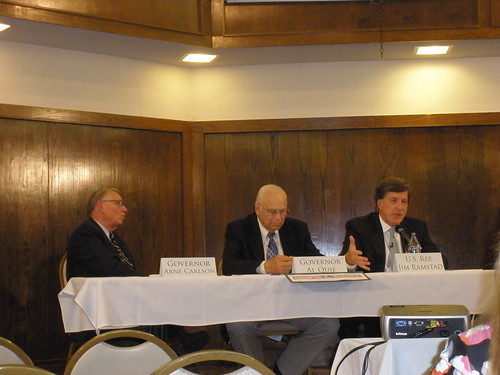
Yesterday morning I went to an event sponsored by Growth and Justice, a think tank in Minnesota that takes a more moderate pro-business view than other conservative groups. The event highlighted former Minnesota Governors Al Quie and Arnie Carlson, as well as retiring Congressman Jim Ramstead. The idea was to highlight how these were Republicans who were committed to social justice as well as promoting business growth.

The group's president, Dane Smith, opened the event by saying, "It's good to see so many fire-breathing radical moderates in one room." He noted that Minnesota was among the top ten states in economic growth at the same time it was one of the top ten most heavily taxed states--that is, "until recently." He talked of the state's tradition in investing in education and health care. Of the speakers, many are known for being moderate Republicans, and each has a crowning social justice achievement.

Ramstead has co-sponsored the Mental Health and Addiction Equity Act, something that Paul Wellstone pushed for during his time in the Senate. Ramstead said he expects the bill to be passed and signed into law this September.

Quie inherited a budget crisis while governor, and is often hailed for his fiscal responsibility. Lately, he has devoted himself to social justice causes such as the prison crisis and education for children with disabilities.

Much like Quie, Arnie Carlson's role as governor was highlighted by tackling a budgetary crisis. He established what's now known as Minnesota Care, a program that provides health insurance to low-income families. He also pushed for the anti-discrimination laws in Minnesota to include gays and lesbians--a move so controversial that Republicans didn't endorse him for his re-election campaign in 1994, when he won the majority of the vote, something that hasn't happened in a gubernatorial election since.

The significant thing about this event is that the moderate Republicans on the panel criticized the "no new taxes" and caps on tax increases that have been common with conservatives in recent years. These moderates favored a balanced budget and social programs for the poor over voting "no" on tax increases at every opportunity. Smith pointed out that in 2006, during Governor Tim Pawlenty's re-election campaign, 200 of Minnesota's wealthiest individuals took out a full-page ad in Star Tribune to declare that they could afford to pay more in taxes.

But looking around the room of "radical moderates," many of them fell on the later side of life. Fewer than half a dozen people in the room were under 30, and of those many were reporters or staffing the event. Whether that means that young people today are more extreme than in the past or that moderates are having a harder time reaching out to young people it's hard to say. But it's interesting how such moderate voices are rarely reflected in the political debate today.

Cross posted at Pushback.

Tuesday, September 2, 2008

Covering the RNC


Sorry to have not posted recently. I've been busy flying from Denver to DC and then to Minneapolis to cover the Republican National Convention. Already the tone is very different. After cutting back on events the last couple of days, the Republicans, at least in my personal interactions (perhaps because they know about the Center for American Progress, my employer) seem to be more on the defensive than the Democrats were last week. Minnesota Public Radio has already devoted several segments to the question of Sarah Palin's viability as a vice presidential candidate. I'll be reporting more over at Pushback, but in the meantime, here's a rather humorous logo to entertain you.

The Problem with Choosing Sarah Palin

Today’s theme at the convention is “Who is John McCain?” The question has become more or less abandoned recently. Over the last several days, gallons of ink–digital and otherwise–has been spilled over McCain’s vice presidential pick. Because Sarah Palin was relatively unknown in the national scene, reporters and bloggers have been spending a great deal of time trying to uncover her political history. Already, the minor scandals Troopergate and Babygate have bubbled up. Conservatives went on the defensive almost immediately trying to assure everyone that Palin has enough experience to be the vice presidential nominee.

By choosing someone with a relatively unknown past, the national attention has dropped from the top of the ticket to the bottom of it. Already Palin’s garnering louder cheers than McCain from some conservative groups. Although she brings energy to the ticket, especially from religious conservative voters, she has also energized the left because of her socially conservative positions. With such a controversial figure on the ticket, the debate has become more about Palin than the differences between the two parties.

It’s too early to say if this is going to be a lasting narrative in the campaign or a blip around the Republican National Convention. But it may be difficult to focus the campaign on the top of the ticket, even if the theme tonight is getting to know McCain.

Cross posted at Pushback.

Related Posts Plugin for WordPress, Blogger...