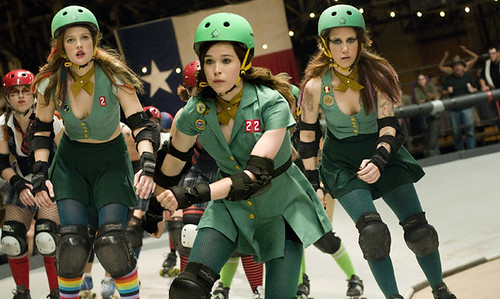
The new remake takes care to pluck some of the more feminist-themed language from the novel and depict some of the key scenes that transcend the relationship from fairy tale to realistically complicated relationship. Freedom is a key theme in Jane Eyre, and much of it has to do with the freedom of women in this time.
Tuesday, March 29, 2011
Re-imagining Jane Eyre
The new remake takes care to pluck some of the more feminist-themed language from the novel and depict some of the key scenes that transcend the relationship from fairy tale to realistically complicated relationship. Freedom is a key theme in Jane Eyre, and much of it has to do with the freedom of women in this time.
Monday, March 21, 2011
Big Love's Experimentation with Feminism
If you watched the series finale of Big Love last night and if you're not ready to give up on Big Love, be sure to read my piece that ran in The Atlantic over the weekend in anticipation of the finale:The hallmark of Big Love is its ability to dive into modern social issues that are seemingly beyond the scope of the Utah polygamist family at its center. One of the show's creators said on a HBO featurette about the series, "There was something almost a little bit retro, you know, '50s American suburban family about the Henricksons and I think we were turning that idea on its head a little bit."Keep reading ...
Spoilers ahead with some final brief thoughts on the finale.
The series ended more or less with the same themes they'd established throughout the show. I thought the way they did away with Bill's character was a bit cheap, but it seemed obvious that Bill couldn't continue in his role as the patriarch of the family. This whole season demonstrated that he was slowly losing control over the life he had built for himself. Eventually everything gradually slipped away -- the casino, the state senate seat, Home Plus, his wives, and finally his life. Each of the women began to express desires for something beyond the family (which I talk about in my Atlantic piece).
Wednesday, February 16, 2011
Girls Just Wanna Have Guns. Then All the Rape Will Stop, Right?
(Breitbart)Remember Hannah Giles? Well, her sister, Regis Giles, is getting a new show about her shooting guns. Also, apparently she doesn't believe men and women should be equal. Read my interview with her on Campus Progress from when I tracked her down at CPAC last week.
Regis Giles, who spoke on the student activism panel at the Conservative Political Action Conference Friday, comes from a family of conserative activists. You've most likely heard of her sister, Hannah Giles, who partnered with James O'Keefe in videos that helped bring down ACORN. Her father, Doug Giles, is the host of Clash Radio and spokesperson for "family values." But Regis is branching out on her own, with a new television show in the works called "Primal Urge" in the works on the Pursuit Channel. Campus Progress caught up with Regis to talk aobut her current project, GirlsJustWannaHaveGuns.com, her upcoming television show, and why she doesn't identify as a feminist.
Tell me a little bit about your website [Girlsjustwannahaveguns.com].
My website has my logo on it. In my speech you know, it's also, my company's main objective is self defense. You've seen in the news where women have been jumped and you see the security cameras where they can't do anything. You see them shoved in their cars, ducking down. If they had a gun on them. That would've been a little bit different. If they would've had a gun on them, their life would've been a lot different. They wouldn't have that horrible experience of actually being raped or abducted or even killed. That's what my company stands for.
Attacks on Women From All Directions
(Flickr/Claus Rebler)- Legislators in Fredrick County, Maryland are justifying cutting of funding for Head Start because, apparently, women should be at home with their kids.
- South Dakota wants to kill its one abortion provider. Though the state legislator, Phil Jensen, who introduced the bill insisted this is about killing a fetus in a domestic violence situation because evidently current homicide law that just covers the killing a woman isn't enough.
- Florida is trying to pass a bill that bans fetal pain, something that isn't even actual science.
- And there's all kinds of other crazy anti-choice legislation in lots of states.
- Oh yeah, and Republicans want to cut family planning funding. In DC alone, more than 35,000 women needed Title X funding. See how family planning funding is spent in your state.
- ALSO, Justin Bieber doesn't believe in abortion. Probably because he'll never have to have one. Teen pop star FAIL.
Monday, February 7, 2011
Survey of Match.com Users Says Feminism Is Working
(Flickr/ZakVTA)According to an article in LiveScience, a new survey of Match.com users finds some counter-intuitive responses from the men and women surveyed. Among its findings:
- Among people who didn't already have a child, 24 percent of men wanted to have children compared to 15 percent of women;
- When asked whether women should be the primary caregivers of children in a family, 49 percent of women said no while 38 percent of men said the same;
- Among singles ages 21 to 34, 62 percent said they wanted to get married, 9 percent definitely didn't want to get married, and 29 percent aren't sure.
The article even quotes Stephanie Coontz, who wrote Marriage, a History: How Love Conquered Marriage
Though the survey is far from hard-hitting science, since it relies on a self-selected sample of users of one particular dating service, it does suggest some changing attitudes among people who are interested in dating. The fact that more men and women are both indicating shifting attitudes from what was standard in the 1950s and '60s means that at least to some degree, the idea of gender equality -- also known as feminism -- is working. True, we haven't yet reached the point at which all men and women agree child rearing isn't mainly the responsibility of the woman, but we are at a point where nearly half of women believe that and a significant portion of men do.
Many times when various individuals offer dating advice, one of the key things they point out is that you should be on the same page about major life decisions or it will ultimately end up as a difficult -- or even bad -- partnership. The point about whose responsibility child rearing is seems like an important thing to be on the same page about.
Thursday, January 6, 2011
Looking at the Source on New 'Study' That Says Women Want to 'Marry Up'
(Flickr/Mr. Physics)I was all set to write a snarky blog post about this recent article in the British Telegraph that says a new "study" finds that women don't really want equal pay and a career. Instead, says Dr. Catherine Hakim of the London School of Economics, that women really just want to "marry up." But then I realized that this was an actual News Article published in a serious Newspaper and that people might take it seriously. Sometimes folks think the British are more trustworthy -- possibly because they add extra letters to words and have authoritative accents.
Let's start with the newspaper that published the article. See, Brits don't have our weird American obsession with objective journalism. Instead, they adopted long ago what we have adopted more of today. According to NPR's helpful map of British newspaper ideology, The Guardian is back by the UK's Labor (liberal) party, while the Telegraph is backed by the conservatives. This quote from a conservative member of parliament pretty much says it all:
"If a Guardian journalist were to interview me, I would definitely assume that they would be trying to penetrate into areas of weakness in what the government is doing ... or particular policies that they are very worried about," says Nick Boles, a Conservative member of Parliament from England's East Midlands region. "Whereas with The Telegraph, they'd probably be more likely to be ... looking for ways in which the government was betraying the Conservative cause."So I guess the Guardian is more similar to the American Huffington Post while the Telegraph is more similar to more conservative news outlets like the Daily Caller or the Weekly Standard.
Meanwhile the place that published the study mentioned in the Telegraph article is the Centre for Policy Studies, which is basically a conservative think tank. It was founded, according to its own website, to "'convert the Tory Party' to economic liberalism." It also looks like the think tank has picked up more of a socially conservative bent over the years. From CPS' page on "social policy/family":
The family is at the heart of society. Evidence from a wide range of UK and US sources show that children who experience family breakdown or who grow up in fatherless families are at much higher risk of poor outcomes: from educational failure to drink and drug abuse, from crime and teenage pregnancy to unemployment and relationship breakdown.UK fiscal policy should be reformed to support marriage through the tax system and to remove the welfare penalty on two-parent families. State intervention in family life should focus on protection of vulnerable children; it should not extend to managing their day-to-day lives and removing responsibility and judgment from parents.
CPS also held an event last March titled "How the sisterhood fails mothers." And the title of the study cited in the Telegraph article is actually titled "Feminist Myths and Magic Medicine," and the text of the study itself sounds a lot like gender essentialism from the days of yore. Hakim notices that few women are high economic achievers, so she concludes this must be because women don't want to be high economic achievers. In short, the research seems to conclude that feminism has been around for a few decades and we don't have gender equality yet, so it must not work!
Sounds like pretty standard social conservatism here in America. In other words, it sounds like citing a study about women in the workforce put out by CPS would be similar to one put out by the Heritage Foundation.
One of Heim's key findings in the study she put forth is that "Despite feminist claims, the truth is that most men and women have different career aspirations and priorities." She simply observes a pattern and doesn't delve into why women "want" different things from careers than men and doesn't spend much time diving into what forces might shape those different desires.
Hakim herself is known for criticizing feminist theory, and has recently put forth work on "erotic capitol" or the idea that sexual appeal can result in economic capitol. This is yet another gender essentialist idea that at best makes feminists uncomfortable.
So next time you see an article that puts forth claims that new research finds women don't actually want equality, it might be useful to spend some time thinking about who is saying that and why.
Wednesday, June 9, 2010
Something to Read and Think About
Monday, June 7, 2010
Feminist Hulk: as Awesome as Everyone Thought
There are some concepts that are awesome to those that sit at the intersection of extremely niche subsets of the population. A perfect example of that is femisthulk, at Twitter personality created by someone only known as his “literary life-partner, J.” It gets right to the heart of feminist comic book nerds. Over at Ms.'s blog, Feminist Hulk and J do an interview with the magazine. I think my favorite part might be when Feminist Hulk says, "HULK HAVE PENIS, IDENTIFY AS MALE, SO HULK COULD BE CONSIDERED CISGENDER. HOWEVER, HULK DELIBERATE IN CHOICES, RESIST PRESSURE TO NATURALIZE OR PRESCRIBE GENDER SCRIPT. SO, HULK COULD BE GENDERQUEER. DEFINITELY HAVE GENDERQUEER POLITICS."
Tuesday, October 6, 2009
Whipping the Sexism Out of Whip It's Box Office Numbers

Apparently Whip It, starring Drew Berrymore and Ellen Page, didn't do so great at the Box Office last weekend, pulling in about $4.9 million. The male-dominated cast of Zombieland dominated, trouncing all other movies with $24.7 million last weekend. (To be fair, zombies are amazing.) But critics say Whip It is a pretty good film. It's getting 81 percent over at Rotten Tomatoes, just 8 points behind Zombieland.
Over at NPR, Linda Holmes doesn't understand why the film is doing so poorly. "Not only is it touching and funny and a rollicking good time, but it's a movie that rarely finds its way to the multiplex -- it's a sports movie about a team of women, it's got a cast chosen mostly for suitability and not perceived hotness, and it's warmly funny but almost wisecrack-free," she writes.
Box office numbers do matter, though. Melissa Silverstein, who writes the blog Women & Hollywood writes, "I am seriously sad." Many people viewed Whip It and Jennifer's Body (Diablo Cody's adventure into feminist horror fimmmaking) as the rise of the film starring young women. "So now we won’t have movies about older women and we won’t have movies about younger women," Silverstein writes. "Great."
As Silverstein has noted often, films that star women are few and far between. And films that do star women (and are directed by women) become "underperforming films," Silverstein writes, though they are often produced on small budgets so they still usually make a profit, even if they don't do so hot at the box office. And that's not to say that Whip It won't do well eventually. It might. After all, Julie & Julia, the Julia Child/blogger biopic, is still raking in a reasonable amount of money (outperforming, ahem, G.I. Joe) even though it came out over the summer. And as I recall Juno wasn't an instant hit either. Many word-of-mouth films don't have a smash opening weekend but end up performing well overall because the public wants to see it after hearing from a friend that it's good.
Silverstein has done a phenomenal job of pointing out that there just aren't enough films written by, directed by, or starring women coming out of Hollywood. The problem is, Hollywood executives will look at a film that didn't take top spot at the box office produced by women, even if it ultimately ends up making a profit, and assume that it performed poorly it's because it was produced by women. Then they'll back fewer films directed by women. It's a bad cycle.
Worst of all, people are starting to put Whip It and Jennifer's Body in the same category. Because, um, I guess we have to put all women-produced films in the same category? That's like putting Drag Me to Hell in the same category as The Hangover. I guess they are lumping the two together because they're both "female empowerment" films. God, that's horrifying.
It's useless to look at Whip It in a vacuum. If there were gender parity in the films that Hollywood produced, I think you'd end up seeing that films directed by women "underperform" at about the same rate as male-produced films. It would be nice if feminism didn't have to put all of its eggs in one basket every time a film is written by, directed by, or stars women. As it is now, as a feminist, I feel like I failed because I didn't block out time to see Whip It this weekend. I plan to see it soon, but because I didn't see it on opening weekend, my voting dollars somehow count less.
But let's be clear about one thing: Hollywood produces a ton of crap every year that doesn't take a top spot at the box office on opening weekend. Much of it is produced by men. But Hollywood still produces crap produced by men. Hollywood execs shouldn't look at films like Whip It as failures because they're directed by and star women. Looking at Whip It as an indicator of whether women's films can and should succeed is dangerous business and downright silly. Let's hope movie executives realize that.
Cross posted.
Monday, May 4, 2009
Talking Naomi Wolf
I suppose I shouldn’t be surprised that a review of Helen Gurley Brown, founder of
100 ways to please your manCosmopolitan magazine, prompted Naomi Wolf, a sort-of feminist writer who we’ve locked horns with before, to proclaim that “sexy” feminism has won out over humorless, hairy armpit feminism.“[W]hen it comes to women’s rights,” Wolf wrote in this Sunday’s Washington Post, “Americans have clearly matured. What has helped that process along is that stealthily, quietly, second wave feminism — the movement personified by Betty Friedan and her 1963 bestseller, The Feminine Mystique — has been supplanted by ‘third wave’ feminism, with its more upbeat and individualistic signature.”
Much of what Wolf writes suggests she’s far out of touch with what’s going on in feminism today, and she seems to forget that feminists are actually doing things of value these days. The National Women’s Law Center is pushing to make women’s voices heard in the health care debate. The first bill that President Obama signed into law was legislation that helped women sue for pay discrimination, thanks to many women’s coalitions. Not to mention all of the volunteer work women are doing on campus, staffing emergency hotlines to aid victims of domestic violence. As the work of modern feminists shows, there are plenty of women that fall outside the narrow stereotypes Wolf presents.
Go ahead and read the whole thing.
Monday, March 30, 2009
Is There Such a Thing as a Pro-Life Feminist?
Today, Jessica Valenti posted this video from Feminists for Life, saying that a fairly common question she's gotten when speaking at college campuses lately is if pro-life women are allowed to call themselves feminists. The debate, it seems, is peaking up all over the place.
What I find so interesting about this argument is that it doesn't ask if women can call themselves feminists if they don't support work/life balance policies, or if they don't support equality in the workplace. It seems obvious if these women don't support such things that they aren't feminists. But this debate reveals that everything is ultimately about the reproductive rights debate. The question about who is allowed to call herself a feminist is ultimately about choice.
The video that Jessica posted is a speech given by Karen Shablin, member of Feminists for Life, talks about her conversion. But some of the key parts of her speech are the most subtle ones. She says that she believes life begins at conception, something put forth by the personhood movement. It is also something that, if codified into law, would prevent women from accessing not just abortion but also birth control, Plan B, and subject miscarriages to investigation. These are the details that pro-life groups leave out when they advocate for their version of "feminism."
I tend to agree with Jessica -- what this is about is actually a legal question. Once groups decide that they want to legally restrict the rights of other women to have an abortion, the result is not just that they don't necessarily deserve to call themselves feminists, but it becomes much more serious. They're attempting to co-opt the word feminism.
This shows how powerful the feminist movement is becoming. Despite the fact that NOW members are bemoaning the fact that young women today "won't use the word" but if the word feminism were declining in popularity, it's unlikely that pro-lifers wouldn't even bother with it. It is precicely because feminism is gaining so much popularity and momentum that anti-choice women want to co-opt the word to make it mean something different. The tactics of groups like Feminists for Life might be different than those used in the past, but it's the same old stragegy of trying to deminish the work of legitimate feminists out there.
Must-Read Feminist Books this Spring
- Quiverfull: Inside the Christian Patriarchy Movement
by Kathryn Joyce
- The Purity Myth: How America's Obsession with Virginity Is Hurting Young Women
by Jessica Valenti
- The Means of Reproduction: Sex, Power, and the Future of the World
by Michelle Goldberg
Wednesday, March 18, 2009
More Divisive Women's Poltics
As I once outlined, older feminists have a sense of entitlement. They somehow "earn" their right to lord criticism over us young feminists and pretty much whine when we target criticism back at them, as Dickerson's post so aptly illustrates. She actually tells us to "Grow up, girlies."
That doesn't mean I don't appreciate all the accomplishments that second-wave feminists have made. Today, thankfully, sexual harassment is shamed in the workplace instead of being celebrated, even if it hasn't disappeared. Women can legally claim maternity leave, even if it's often unpaid. And the sexual revolution, something second wavers worked extremely hard for, has allowed women to be able to be sexual as well as serious, even if the stereotypes about sluts (ahem, Ms. Dickerson) haven't gone away.
But now, what young feminists want -- and it's important, as Megan pointed out, to acknowledge that few women actually identify as such and that has always been the case -- to be treated as equals in the movement. Just because we are young doesn't mean we somehow care less about pay equity, contraception and abortion access, representation of women in the media, domestic violence, or any number of issues that feminists should care about. But by marginalizing us off the bat, Dickerson is sending a strong message that older feminists don't think much of us and simply aren't interested in hearing what we have to say. And they can't deny that there are a lot of problems with the way her generation of feminists have done things.
By delving into personal attacks, Dickerson isn't helping things. What we need is not to accuse different generations of feminists of slacking -- what we need is to work together to make things better. That means actually listening to each other on substantive issues and staying away from this silly mud-slinging.
Thursday, February 12, 2009
Monday, January 5, 2009
What Does Feminism Mean to You?

Via Jess McCabe at F-Word, this photo project is interesting. Flickr user ycguitar814 asked people at the University of Buffalo to write what feminism meant to them, and the responses were interesting. I'd love to see the project expanded.
Friday, November 14, 2008
Madam First Lady
Emily Brazelon has some feedback on the Rebecca Traister piece on Michelle Obama's "momification" I wrote about earlier this week. Brazelon seems to be giving feminist props to Michelle Obama for her role as mom-in-chief, that the media (and the Obama campaign/administration itself) has recently been promoting. I agree with Brazelon's main point that just blaming the media for this is a little too easy. I also agree that Michelle's role as wife and mom isn't exactly new and it's one that she's been promoting throughout the campaign. I think the answer is much deeper, it's about the illusion of choice many women have. We're seeing though that illusion with Michelle Obama.What we're talking about here at the root of this is the the debate that's been happening since the second wave of feminism. Woman who didn't want to be attacked for staying at home to raise children accuse feminists of going back on their "choice" rhetoric. The reasoning goes that feminists should support the "choices" of women, even if that means a woman "chooses" to stay at home to raise children instead of pursuing a career. And I agree, when a woman (or man, for that matter) decides that raising children is that important, then more power to her (or him!).
The tricky part, though, is that "choices" aren't as open or easy as we like to think they are. Women tend to be at a disadvantage when making these choices thanks to the fact that they are often out-earned by their husbands and the pressure of societal norms that call on women to be caretakers.
Take the pressures on Michelle Obama. Michelle can't really "choose" to be a working First Lady in the White House. That would be weird, right? No other First Lady has done that, and Michelle probably isn't really into breaking. It also seems clear that everyone, Michelle included, is seeking to avoid "repeating Hillary Clinton's rocky first lady performance," as Brazelon said. Clinton flexed her muscles as First Lady, and the result was that she became one of the most polarizing figures in America. The backlash on Hillary's role as First Lady will last for a long time.
So Michelle has been left with extremely limited choices. She probably doesn't want to be as passive as many other First Ladies, but she certainly can't be like Hillary. She may have made her peace with the decision to make career sacrifices for Barack a long time ago, as Brazelon said, but that doesn't necessarily mean it's easy for her. Barack even acknowledges Michelle's resentment of his lack of domestic help in his second book, The Audacity of Hope. In many ways, Michelle's situation is like many other women who are part of powerful couples today and are more or less forced into making hard decisions when their husbands get promotions that are too good to turn down.*
But while I agree with most of what Brazelon says, I thought this line seemed off, "in the meantime, yes, [Michelle] is the one honcho-ing their physical move, or at least whom to delegate it to. I hope so! Because I want my president-elect working on other pressing matters like our economic crisis." It may be true for the Obama's that Barack's job is too important for him to be an equal partner in household affairs, but I think such justifications are liberally applied to other men with "important" jobs. Are the cultural expectations really so different when the man is president of a company or running his own business? The conventional wisdom is that we can't expect men to share in household work because their jobs are too important. Women's jobs, on the other hand, are almost never considered more important than family responsibilities. I have a hard time believing that people would be so generous to Michelle if the Obamas' roles were reversed, and it was she that was too busy to pay cursory attention to finding the right schools for her daughters because she was dealing with the country's economic crisis.
In the end this debate is just a redux of the "mommy wars" that resurface every few years. I never found these screaming matches very useful. But the one good thing to come out of them, as shrill and awful as they were, is that men need to be expected to help with the responsibilities of home and children equally, no matter how busy they are. In the Obama's case, it may not be possible, but it's probably the only exception I can think of. We also need to stop assuming that just because women have children they must want to give up a career. Unfortunately, Michelle's situation has sparked this debate once again.
*For the vast majority of women today, working isn't a luxury; it's a necessity. Most women must work because they have to. It isn't a choice for them.
Friday, October 24, 2008
WaPo Says: Feminists Go Home Already
This quote I thought was especially odd, from a Planned Parenthood division:
"It's going to take us a while to find our bearings," said Sarah Stoesz, who runs the Planned Parenthood office that oversees Minnesota and the Dakotas. "As feminists, we've always thought that a core aspect of women's equality is about being in control of our reproductive lives. But Sarah Palin is throwing the calculus out the window and demonstrating a view that some people would call feminism: I can be governor, I can have five children, I can shoot and field-dress a moose, and I don't need access to abortion."Wait, what? So because Sarah Palin, the first Republican vice presidential nominee doesn't need access to abortion no one else does either? That just doesn't even make any sense. The whole idea behind the pro-choice movement is that women are welcome to make their own choices about whether or not they want to have an abortion. Sure, Sarah Palin didn't want one, but that doesn't mean other women don't. Many women out there need access to abortion and are having a very hard time obtaining one.
The article also quotes Geraldine Ferraro, who has turned out to be something of an embarrassment for feminists thanks to her racist remarks about Obama. Ferraro falls into the Camille Paglia category of
The article also seems to argue that because Palin calls herself a feminist, that automatically makes her one -- they do the same thing with Independent Women's Forum and Feminists for Life. Lately the right has been co-opting the word feminist but actively work against everything feminists work for. They seem to forget that just because some women make achievements doesn't mean the work of feminists is over, it means simply that some women have made achievements. Ultimately what we need to measure feminism by is not the class of women who live in privilege, but by the quality of life for the women at the bottom who are the most marginalized.
Tuesday, September 30, 2008
Ugly Betty's New Season
I finally managed to get around to watching my DVRed Ugly Betty season premiere. (Spoilers to follow.) Last season they ended it with Betty's simultaneous romances: Henry, who fathered a baby with his ex-girlfriend and lives across the country, offered a marriage proposal, and Gio, sandwich shop owner, offered up a months-long trip to Europe together. The writers made a pretty unconventional move for a show with an audience as girly as Ugly Betty's: she rejected both offers and decided to stay single because she has so much to experience still in life, including breaking out of assistantship.But immediately after making an awesome feminist choice like choosing to live her own life and not follow men, she makes a series of really stupid mistakes. First, in an attempt to brandish independence, she foolishly commits to renting an apartment in Manhattan without looking at it first. Aside from the fact that the apartment is ridiculously large for a studio in Manhattan, it is, of course, leaky and in shambles. Second, she returns to work to find that her boss has been assigned to run a Maxim-esque magazine called Player. Instead of calling her sexist coworkers on their obnoxious behavior, she offers up a tense smile and puts up with it. Finally, in an attempt to save her well-meaning but somewhat inept boss, she hops on a motorcycle to save the day. Riding a motorcycle when you don't know how is ridiculously stupid and dangerous.
I get that Ugly Betty's thing is that it's supposed to be filled with caricatures and over-the-top (some of the best of them are Marc and Amanda, who barely made an appearance in this episode), but this just seems more than silly. The best past moments of the show were when we could really identify with Betty's hopes and dreams through her odd color parings. And the satirization of the women's magazine industry (complete with eating disorders) was sometimes spot-on. But if they don't start bringing the show back to its roots with a combination of lovable corniness and homages to Spanish-language TV novellas and a little less American-style comedic plotlines, we won't be seeing any more of Ugly Betty.
Monday, September 29, 2008
Sarah Palin’s Name Is a Boost for Both Sides
Cross posted on Pushback.