Showing posts with label gender roles. Show all posts

Wednesday, March 2, 2011

The Bright Girl List

Via Sadie at Jezebel, Heidi Grant has a theory about Bright Girls:
Bright Girls, when given something to learn that was particularly foreign or complex, were quick to give up; the higher the girls' IQ, the more likely they were to throw in the towel. In fact, the straight-A girls showed the most helpless responses. Bright boys, on the other hand, saw the difficult material as a challenge, and found it energizing. They were more likely to redouble their efforts rather than give up.

[...]

Are there things you decided long ago that you could never be good at? Skills you believed you would never possess? If the list is a long one, you were probably one of the Bright Girls.
Ugh, I really hate it when theories explaining sexism or gender differences ring totally true to my own experience. Therefore, here's a list of things I gave up on being good at pretty early in life.
  1. Playing piano. (Let's face it. I really hated practicing.)
  2. Playing clarinet. (Same reason.)
  3. Playing alto saxophone. (Don't worry, I'm getting to non-musical related things soon.)
  4. Math. Like tons of other girls, I was really good at math throughout high school, but then when I fit my three years of requirements, I stopped instead of going for pre-calc even though my geometry teacher encouraged me to pursue a career in math. I guess I believed the stereotypes.
  5. Cooking. Well, at least this was true for a long time. Because cooking was something that women were supposed to be good at it, I stayed away for a long time.
  6. Video games. I always got really frustrated that I wasn't good at these right away. I guess I missed that you have to spend hours and hours on this to get better at it.
  7. Fashion. Same with shopping. I hated it as a kid and have only gotten to like it marginally more as I get older, thanks mostly to online shopping. I find going to stores tiresome and I'm not particularly fashionable.
  8. Economics. It took one class in college to convince me I was no good at this. Do I get points for listening to the Planet Money podcast?
This list could be much longer, but I'm going to avoid going down that ego-stripping path. The point is, women seem to judge themselves much more harshly than men do. Or at least, I find that anecdotally true.

Monday, January 10, 2011

The Problem With 'Like a Man' Articles

(Flickr/Chris_J)

Today the Wall Street Journal has some advice on what women can learn about dressing well. The solution, it seems, is to "shop like a man." The piece itself offers some advice on looking for quality and comfort over labels and style -- something that my mother who sewed many of her own clothes over the years would likely raise her eyebrows at the idea that these are "masculine" qualities.

See, there's a problem with the "like a man" genre of article -- and there's no shortage of them. Women are frequently told to ask for a raise like a man, Date Like a Man, and even pee like a man. But the problem here is that "like a man" is often synonymous with "do it better." When women are given advice on asking for raises "like a man" it's because women are often paid less than men, and it's often thought that the solution is to simply mimic men's behaviors to receive the best results. Same goes for dating and peeing -- the idea is that men somehow do it better. The way to fix that seems to be to tell women how to be more like men.

There's a reason there isn't a genre of "like a woman" articles for men. (Except for this Daily Fail Mail article on a man who spent a week "living like a woman.") See, the idea is that men would never want to be "like a woman" because women are generally considered inferior, even though if you replace "like a woman" with "better," you could write articles on how men should drive like a woman, how to multitask like a woman, or how to fly a fighter jet like a woman.

But you don't see articles like that -- or at least, not nearly to the frequency with which you see "like a man" articles.

In the case of the WSJ article, it was talking about ways that men and women's clothing industries differ. But while women's clothing is often made, marketed, and sold in ways that are different than men's clothing, it's a shame to write the article in a way that assumes all women go for more cheap clothing over men, who buy fewer quality pieces. After all, there are plenty of women who don't like to buy shirts with mismatched stripes, spend time looking at quality over labels, and refuse to buy fabrics that aren't comfortable. Let's stop with the gender essentialism.

Tuesday, May 18, 2010

Is Lisabeth Sandler Feminist? Sort Of.

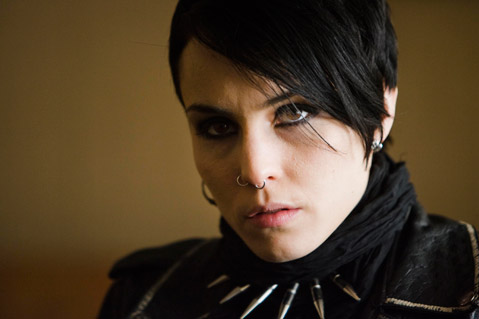
I was interested to read the recent discussion in the blogosphere over whether Lisbeth Sandler (spoilers ahead), heroine of The Girl with the Dragon Tattoo (and subsequent sequels The Girl Who Played with Fire and The Girl Who Kicked the Hornet's Nest) is a feminist figure. It's a question I contemplated while reading the books and watching the made-for-European-audiences film.

Nina Shen Rastogi writes at Slate's Double X:
On one hand, she's a super-smart, takes-no-guff, possibly-Asperger's-having hacker: Awesome! Lisbeth felt like something fresh and different and cool when we first met her: A character who wasn't going to pander to our need to like her. But then, in the second half of Dragon Tattoo (spoiler alert), Larsson has her fall in love with the hero, Mikael Blomkvist, in a way that really irked me. My friend pointed out that Blomkvist comes across like a bad Mary Sue character—i.e., a wish-fulfilling stand-in for the author. (Larsson, before he died, was also a middle-aged, crusading journalist.) The novel portrays Blomkvist as having this mysterious sexual power over women without really giving us a reason to understand why; it just insists that this is the case. And there's nothing about Lisbeth that suggests she would be vulnerable to his inexplicable charms—she has utterly rejected every other kind of human attachment thus far—and yet, she succumbs! Hard! To me, that felt like bending a character unnaturally to fit the logic of the romantic suspense story, and it made me angry. And then, at the beginning of The Girl Who Played With Fire, when Lisbeth gets a boob job, I just threw up my hands.
The primary way to think about The Girl with the ... series is to first remember that Sandler isn't the main character. Blomkvist is. The story is largely about a passionate (male) journalist that is, to use a word I don't really agree with, kind of a slut. As Shen Rastogi writes, the character of Blomkvist is eerily similar to the author's own biography.

Sandler is a somewhat complicated figure -- I, too, found the breast implants giving her a new sense of confidence odd -- but she is most definitely a strong female character, something often lacking in American media. And much as I'd like to see more feminist characters in popular culture, I don't have a litmus test and recognize that a less-than-perfect character makes for a more interesting one. Sandler is tough as nails but she's also extremely damaged. Is that feminist? It is and it isn't.

Finally what's important to understand about The Girl with the ... series is that the whole thing is uniquely Swedish. Sweden is, in itself, an oddity among Western countries. It comes with a litany of social (the right might even say socialist) policies -- what people seem upset about is that men aren't taking enough paternity leave. There has long been a strong feminist movement in Sweden; the country has the second-highest percentage of women in parliament. And though human trafficking is a key plot point in the series, it is often regarded as the country that has taken the most progressive and harm-reducing measures toward prostitution generally. Punishment toward johns is harsh while the sale of prostitution has been decriminalized. The books' attitudes toward marriage (which didn't really appear in the film as much), highlighting a very open marriage, was also very Swedish. In Sweden, marriage is viewed as a purely religious institution and most Swedes identify as not particularly religious. Marriage trends have been on the decline in the country. While Sandler may not be particularly feminist herself, she comes from a place with very feminist policies.

In other words, Sweden has a very, very different attitude toward gender politics than Americans do. It seems odd to me that we have feminists decrying such a Swedish book for not being feminist enough. I only wish that America produced the kind of literature that took human trafficking seriously, wrote strong (albeit damaged) female characters, and took more progressive views toward gender roles. And that is why I think an American version of the film will hurt my soul.

Thursday, April 1, 2010

The Problem with Mentorship

Fortune has a story on "The New Valley Girls" -- Silicon Valley's ladies with power, drive, and ambition. The story seems to focus on the idea that these women aren't using social media to network.
The clock has just struck seven on a Thursday night, and Sheryl Sandberg is networking furiously. Not on Facebook, the site she joined in March as COO and where she boasts 1,114 "friends." No, she's doing it the old-fashioned way, in her Atherton, Calif., living room. She hosts her Silicon Valley soirees a few times a year, and it's always the A-list crowd.
The fact that these women rely on traditional face-to-face networking doesn't come much as a surprise to me. It also doesn't surprise me that women in a field dominated by men have a desire to gather and talk to each other about their problems and failings.

One point that I did find interesting was that these women -- by no accident -- find mentorship from men:
Similarly, Facebook's Sandberg says that her mentors have been men. The first key man in her life, besides her ophthalmologist father, was Larry Summers, who taught her economics her junior year at Harvard. "She wasn't one of my students who raised her hand all the time, but when the midterm came, she got the best grade by some margin," recalls Summers, who went on to be her thesis advisor.
Women do find comfort in talking to one another, but in the male-dominated world of Silicone Valley, they often need to find men to take them on as protegees or they may end up with no mentorship at all. In fact, many of the more successful women in political journalism I know do have male mentors. This can be awkward, like in the recent Newsweek piece on sexism in the office, in which a young female employee admits feeling uncomfortable with casual conversation with male colleagues in the office.
One young colleague recalls being teased about the older male boss who lingered near her desk. "What am I supposed to do with that? Assume that's the explanation for any accomplishments? Assume my work isn't valuable?" she asks. "It gets in your head, which is the most insidious part."
I think it makes male colleagues uncomfortable as well. They want to be helpful without coming across as creepy. But the notion of men and women as not being friends can be so ingrained with some people that that power dynamic is hard to navigate. The best advice I can give to my male colleagues and friends who desire to provide mentorship but don't want to come across as creepy, all I can say is this: Just don't be creepy. Acknowledge when you're trying to help and be clear about the fact that you're not trying to make them uncomfortable.

Tuesday, February 23, 2010

The Millionaire Matchmaker Meets Her Match?


Emily Gould interviews Patti Stanger, AKA the "Millionaire Matchmaker." I saw several outraged tweets about this:
"I think men have lost their balls," [Stanger] says to [Gould], when I ask whether there's a "crisis of masculinity" in America. "I think they're hiding them somewhere and they haven't taken them out of the closet and dusted them off."
And this:
"But if you think of that $200 every six weeks as, like, an investment in your man future… you should always have a little fund that you play with, on the side, and you say, I am not going to spend this weekend buying five drinks at the bar this weekend at $15 a pop. You can always get men to buy you drinks. Maybe you buy the first one, but not the second one. There's tricks to the trade. Maybe you're not gonna spend $500 on a dress that you wear twice. Maybe you go to Loehmann's instead."
And, especially, this:
"If a woman makes more money than a man, the minute she pays for everything, she becomes the man. If she chooses to be the man, if she enjoys being the man, if she doesn't want to be a female, it's OK. It works if the guy is OK with being the female."
Oh man, it's hard to imagine that a woman who auditions women to come to mixers with millionaires (until recently, Stanger refused to work with millionairesses) holds some kind of regressive stereotypes. Imagine! If you thought a woman who essentially marketed models and actresses to selfish, immature pricks for a hefty fee was some kind of feminist, boy would you be wrong.

Sorry to give this whole thing the sarcasm treatment, but Stanger is successful precisely because she holds these regressive stereotypes about men and women. Of course Stanger wants men who don't make lots of money to feel emasculated. In her mind, the more millionaires, the better to line her pockets with. And, as Yglesias points out, there's some social science to suggest that that wages do (unfortunately) play a factor in choosing marriage partners.

Now this isn't to suggest that Stanger's attitudes are some kind of act. I've seen the show. She makes no secret of her old-fashioned attitudes. In fact, her number one rule is that the people she sets up are not allowed to have sex on the first date (actually, I assume this is so that Patti won't get into trouble for running some kind of high-class escort service) because she's all about getting her clients to find love and marriage. She also constantly tells women they have to professionally blow out their hair to attend her mixers. Stanger buys into very old stereotypes about the roles of men and women. (The article says she went to a "soulmate psychic" for cripes sake. She's not exactly unwilling to buy into bullshit.)

But I'm finding it hard to muster the same amount of outrage I saw some of my friends exhibit. Stanger exists for people that want to buy into those stereotypes (and the people who want to "ironically" enjoy her rants). But if we're going to start policing the airwaves with feminist rage, I can think of about a dozen shows I would rather direct my energy at than Stanger's. I think the appropriate response here is to laugh. Then move on with your life.

Excuse me, I have to go invest in my man future now.

Sunday, January 3, 2010

Happy New Year, Responding to the "He Decade"

Happy 2010, all. I had a nice long break and saw two three-day long snow storms in two different states (or "state" in the case of the District of Columbia). I had a chance to read some books, see my family, and watch some movies. Good times.

I'm not going to attempt to write a decade-end post or a decade-beginning post, partly because some have argued the decade isn't over yet and partly because the marking of time is arbitrary anyway. There is, however, "decade wrap-up" piece I wanted to blog about today.

Via hortense at Jezebel, the New York Times has a piece today by Alessandra Stanley on the "self-absorbed man" in the aughts. She presents examples like Don Draper on Mad Men, Dr. House on House, and even referencing Jason Schwartzman in the new HBO series Bored to Death (isn't this just the same character Schwartzman always plays?).

Part of me hates to sum up a "trend" in a decade of television because it all depends on what you watch. If you just watched plot-driven shows like 24 or even Lost, you'd find the argument about the self-absorbed man pretty absurd. Still, I have noticed that some of my favorite characters on Mad Men -- Joan and Peggy -- got shoved to the side while the writers dealt with Don Draper's past, something that I became less and less interested in as the season went on.

But perhaps the most interesting thing about the trend piece is how much it isn't a trend. This piece could really be written about any decade since television was invented. Historically, male characters are typically more complex, more interesting, and more self-reflective than almost any female character. All too often, female characters in television play the hot wife of the dumpy comedian, the hot doctor/lawyer/detective opposite more complex male characters, the evil bitch, or the pretty but stupid sidekick.

It's true that this decade has seen more interesting and complex female characters than ever before: Kara Thrace from Battlestar Galactica, Buffy on Buffy (though admittedly I haven't actually seen the series yet), and Kristen Bell in the title character of Veronica Mars are just a few examples.

But by and large, your average female character usually isn't that interesting. (Anyone remember Gwyneth Paltrow in the first Iron Man movie?) To me the real story is that while female characters have made some interesting expansions in recent years, they are on the whole less interesting than male characters. Hardly surprising, when one considers the lack of female writers.

Wednesday, April 8, 2009

Sarah Haskins Is Awesome, Continued

Over at Campus Progress, I have a piece up that I'm really excited about. I got to interview Sarah Haskins about her role as a feminist comedian. (Note: If you don't know who she is, you should first immediately go here to check out her funny videos and secondly admit that you don't read nearly enough feminist blogs.) She also breaks the news to me that she has sold a screenplay:

Haskins has found some small success with her “Target Women” segment on Infomania, but she, like others in Los Angeles, is hoping to make it big. “I just sold a screenplay with my writing partner, a friend I knew from college. That’s very exciting. The protagonists are two girls,” she said. “That’s been awesome and hopefully it’ll get made. That’s sort of the Hollywood thing and where you don’t know if any of that will ever happen.”

Hollywood is known for being a tough town for women writers. As I pointed out in a recent article, only 12 percent of screenwriters in the top-grossing films last year were women. Haskins also noted that in her own experience with peddling a screenplay she felt women in the industry were more receptive to her work. “I feel like female producers maybe on the next level like TV or film are inclined to look at a female-oriented project or pitch and be a little kinder to it. You know, maybe take a second look at it because people are looking for young female writers,” she said. “I definitely have met with more women since I’ve been out here in Hollywood.”

I cannot wait for the possibility to see a film co-written by Sarah Haskins. That film will definitely make $10.75 from this feminist. Additionally, it's important to point out that Haskins has a lot in common with bloggers and eats Cheetos.

Wednesday, January 7, 2009

Mr. PTA President

Today I saw this item in The New York Times that reported the first-ever male Parent Teacher Association president, Charles J. Saylors. Finally, I thought, fathers are stepping up to the plate to take more of an equal role in parenting (although the news item notes that only 10 percent of the total PTA population are men, growing at a rate of 1 percent per year over the last five).

This list toward the end, however, is a bit misleading:

Why all this effort? Because it is good for children. They do better in school and in life when their fathers are involved. The National Household Education Survey by the US Department of Education found that:

Students whose fathers were highly involved at school were 43 percent more likely to receive As.

Children of highly involved resident fathers were 55 percent more likely to enjoy school than those with uninvolved fathers.

Students with nonresident fathers who participated in even one activity at school were 39 percent less likely to repeat a grade and 50 percent less likely to experience serious disciplinary problems.

Let’s not make the mistake of thinking that fathers are the silver bullet to fix achievement and disciplinary problems. It’s true that more men in the PTA is a sign of increased engagement among men, but the reality is that men that are sensitive to these kinds of gender roles probably aren’t single dads in the same way we talk about single mothers. Fathers who are engaged in the PTA probably also have an engaged wife (or husband) who is helping out. Moms involved in the PTA also tend to have less burdensome workloads or be stay-at-home moms. That means the child is less likely to be impoverished, more likely to have a stable home life, and has more parental attention generally. So it’s good that dads are getting into the PTA, but there’s still a long way to go in engaging men in child-rearing.

Cross posted at Pushback.

Wednesday, October 8, 2008

Gender Roles at Fancy Schmancy Restaurants

The New York Times had an article yesterday about gender roles in upscale dining. This article is interesting to me, as someone who’s relatively new to upscale restaurants. Until recently it never really occurred to me to go out to fancy restaurants, partially because I could never afford them, and partially because I grew up in a small town where there just weren’t upscale restaurants available.

So it wasn’t until last weekend, when I was out to dinner with a group of mixed gender and age at an upscale restaurant, that I really noticed the hierarchy in service at such establishments.

Because the way we sat down had the women sitting roughly in the middle of a long table with some men on either side, it became very awkward when the server took orders from women first, then went around each end of the table to take the men’s orders, especially creating problems when some of us weren’t ready to order.

The problem with some very traditional upscale restaurant manners is that they assume things about men and women that may not be true. Another example the article gave is that waiters tend to always consult men on ordering wine, when the woman may be more knowledgeable about the selection. There is, of course, no way for the waiter to know the internal workings of any social group, so it seems to me to pull the emphasis off of assumptions about gender, and ask the entire table about a wine selection and see who might be interested in taking charge. What if a group of colleagues was out with their female boss? Wouldn’t it be insulting to consult a man on a wine selection instead of his superior?

In addition, it seems that the wait staffs add some stereotypes of their own. The article noted that, “A table composed entirely of women may receive the most unequal treatment of all, because some servers may see it as a less profitable opportunity.” Apparently because women tend to order less, the total and therefore the tip also ends up being less. They also note that women “stick around” longer than men do and hold tables. I doubt that this is always true and find it infuriating that wait staff assume women are less worthy customers based on a few observations they’ve made.

Isn’t the point of paying top dollar at a fancy restaurant to have an excellent experience? Creating elaborate stereotypes about women and men that result in women getting treated as “second-class citizens” isn’t worth the price to me. I hope to see these gender stereotypes fall out of fashion soon (as the Times article notes, some restaurants in the Village are starting to buck them). In the meantime I might enjoy some downscale restaurants where you order when you’re ready, the food comes when it’s hot, and the prices are friendlier to my nonprofit salary.

Cross posted at Pushback.

Thursday, August 14, 2008

Time Warp Wives: The Way They Never Were

This article in the Daily Mail about a TV show called "Time Warp Wives" that tries to demonstrate that the best marriages were the ones in the 1930s, '40s, and '50s. They all live in period homes with the male breadwinner model. What's interesting about something like this after reading Stephanie Coontz's Marriage, a History is that I remember that the male breadwinner model, which really boomed in the late 1940s and '50s, was simply never replicated in any other period of history. And in all practicality, the women that had male breadwinner families were at least middle class. The model emerged from a very unique series of circumstances: post-war economy, the rise of the love marriage, the relatively low cost of basic goods, and the real stagnation of women's wages. Poor women simply couldn't afford the luxury of staying at home.

But probably the weirdest thing about this show is the degree of fetishization of the male breadwinner model. Overall, people were much less happy with such marriages. It's not as if women as a whole just decided they no longer desired careers or a life outside the home -- women still desired these things but didn't have an option for obtaining them. It's true that some women were genuinely happy with these circumstances, but women aren't a monolithic group. Plenty felt deeply depressed thanks to a severe lack of outside goals and social interaction.

The show is nothing more than costuming and acting. It's no different than if someone decided they wanted to live in the Renaissance times on television or really any other given period in history. It doesn't really demonstrate anything about marriage today except that some people really get a kick out of dressing up in period costumes and pretending to live in a different era. If you ask me, it's all a little Truman Show.

Tuesday, July 22, 2008

Is Cindy McCain "Perfect"?

The Washington Post has a profile of Cindy McCain by Libby Copeland today. The article does a good job of describing her as apparently everything a president’s wife should be: demure, shy, “half-apologetic,” and “perfect.” Yes, they literally used the words “perfect” and “perfection” to describe her.

But a presidential candidate’s spouse that’s shy and uncomfortable speaking in public, might more often be viewed that as a liability and not an asset. But regardless of whether or not “perfection” is defined by impeccable manners, riding horses, and studying dance, it seems that that’s only one way that someone can be perfect. That version of perfection is rooted in antiquated stereotypes about how women should be quiet, speak when spoken to, and never express an opinion too loudly (if at all).

Cindy McCain’s version of perfection reeks of days gone by. A friend is quoted in the article as saying, “She told me many times that she wanted to be the perfect wife and mother.” There’s nothing wrong with making family a priority in life, but her sheer use of the word perfection suggests that such a thing actually exists. By holding herself to such a standard (unfortunately, a lot of women still believe that they can and will be perfect wives and mothers) she surely lives a very miserable life. With all that pressure of attaining “perfection,” McCain must be exhausted.

The article has very little dirt on McCain (perhaps due to a lack of reporting — I thought the rule when you were writing a profile is that you had to find at least one person that was willing to say something bad about your subject). Perhaps the author was trying to contrast McCain’s persona against her prescription drug addiction and clearly fraught marriage to John, but Copeland really does oversell the perfection bit. McCain obviously isn’t perfect. No one is. I think if Copeland had acknowledged that, the profile might have been less annoying and more realistic.

Cross posted on pushback.

Monday, July 21, 2008

The Marriage Game

Jesse wrote a lengthy post attempting to debunk Courtney Martin's piece in TAP today and Dylan Matthews wrote a long post on TAPPED debunking Jesse's post. It seems that when you talk about the legitimacy of marriage, you strike a nerve.

Marriage is entrenched in a lot of stereotypes and bad connotations across the board. Jesse's argument that we're past the bad things in marriage doesn't really do justice to the fact that for a really long time, marriage has been reinforcing patriarchal culture. This of course is less of a problem for men in heterosexual partnerships than it is for women. Couples that co-habitate tend to see a sharp spike in the women's share of domestic duty and a lag in men's share. This affects couples that live together and aren't married as well, but there are a lot of things about making it legal that reinforce the old stereotypes about the happy homemaker housewife in very subtle ways. The bottom line is that the interpersonal sexual politics of relationships are really tricky to navigate.

Coincidentally, I'm actually reading Stephanie Coontz's Marriage, A History, which debunks a lot of the notions about what marriage "should" be. Basically she examines every assumption we have about marriage today and finds one (or many) societies that just never adhered to that notion of marriage. Marriages have a lot of polygamy, racism, sexism, diplomatic, and social structure histories that show the definition of marriage has changed vastly over time. Furthermore, marriage tends to reflect the values we hold in society.

Every time I get into an argument at a bar about how women shouldn't have to take their husband's names when they get married, I realize that the tradition of marriage is a highly personal thing, even if the implications of the definition of marriage have a much broader impact. For whatever reason, marriage in America today tends to be, on the whole, highly sexist and homophobic still, even if a lot of the taboos about inter-racial marriages have been shrugged off. The reason for this is because American society is still largely sexist and homophobic. Just because it's 2008 doesn't mean those things have stopped existing in society.

In short, Martin is right to be wary of an institution with such historically awful implications. But Jesse is also right that we can remake marriage into something that's more egalitarian if we want to. The problem is that we have to make society as a whole more egalitarian. Both of those things are pretty hard to accomplish.

Thursday, May 29, 2008

She Writes Tell-Alls, Right?

Rebecca Traister has a great essay up at Salon today about how women who write personal tell-alls are often viewed as media darlings. She notes that this phenomenon isn't uncommon among men, but it's important to remember that women writers are a little more versatile than the trope of sex-driven memoirist leads us to believe.

We have to remember: There is nothing wrong with women writing about themselves, their youth, their indiscretions, their habits and values and personal development. Men have been writing about this stuff for thousands of years; they call it the canon.

And like their male contemporaries, a lot of this writing disappoints. When it does, there is nothing wrong with criticizing it. The thing that is wrong -- really wrong -- is when we forget that these kinds of stories are not the only ones that women have to tell.

I couldn't agree more. As a young women, I was often lead to believe that it was acceptable for me to write "human interest" stories or "service journalism" listings, but I often questioned whether I was good enough or serious enough to write about more male-dominated topics. As long as such kinds of writing by women are the only kind glorified, we'll continue to see a slew of Candace Bushnells and Emily Goulds but an absence among many other kinds of writing.

Sexism in Trade Professions

Kate Harding over at Broadsheet asks why more women don't take up trade professions, presumably work like an electrician or plummer. These professions don't require a lot of costly education, she reasons, and the earning power is often on par or higher than other white-collar work. Some women already in the professions are trying to encourage younger women to take up the toolbox.

But I think that Harding forgets that there are plenty of women that already work in trades -- it's just that those trades are very gendered. The standard non-college career for a number of young women I went to high school, for instance, was hair dresser and not auto mechanic. Furthermore, the amount of sexual harassment that most women experience in blue-collar male-dominated professions serves as severe discouragement. For those who saw North Country, I don't think I have to remind you how terrible it was for women driving trucks in the iron ore mines of Minnesota. (Although the movie was set in the 1980s, such harassment still exists.) The problems with women entering high-end blue collar technical trade professions is more about systemic cultural sexism and gendered roles than it is about women just not realizing how lucrative trade work can be.

I don't disagree with Harding that women entering trade professions would be a great step toward gender equality generally, and probably earn those women a lot more than white-collar jobs as an assistant (or even a manager). What would help is first what these truck mechanics Harding points to are already doing, mentoring young women in non-traditional fields. Secondly, unions that represent those industries need to not only be free of sexism themselves, but aggressively pursue lawsuits that would discourage sexual harassment. This is happening with some larger trade unions already, but it's not as wide as it should be. Maybe then Harding's instructions to take up the toolbox rather than the curling iron will be a reality.

Cross posted at Matt's.

Monday, February 11, 2008

Gag Me, Not "Marry Him!"

I wasn't going to write anything on this piece from The Atlantic because, quite frankly, it didn't seem worth my time. Lori Gottlieb's conclusions about just settling for the man that will marry you were ludicrous. I will however, say that I do agree with a small portion of her argument.
When we’re holding out for deep romantic love, we have the fantasy that this level of passionate intensity will make us happier.
I tend to agree that thanks to a lot of trivial romantic comedies and other social expectations, some people get caught up in finding "perfect love" like they see in movies and on television. I'll give her that point. Some people have expectations for relationships that are just too damn high. But I won't pretend that's just limited to women, either.

But the thought that women should just "settle" seems ridiculous. Why should you feed into stereotypes like this?
The dream, like that of our mothers and their mothers from time immemorial, was to fall in love, get married, and live happily ever after.
What's the most silly is that Gottlieb seems to conclude that a relationship is a happy utopia. Even though her married girlfriends seem unhappy they still haven't left their husbands. This is because relationships are actually -- get ready -- a lot of work. Marriage does not necessarily equal happiness. I know it may seem profound to the likes of Gottlieb, but there isn't such a thing as happily ever after, even if you buy into it. She takes evidence from herself, a 40-year-old single mom, and um, Ross and Rachel on Friends to conclude that it's (drumroll, please) the fault of feminists.
To the outside world, of course, we still call ourselves feminists and insist—vehemently, even—that we’re independent and self-sufficient and don’t believe in any of that damsel-in-distress stuff, but in reality, we aren’t fish who can do without a bicycle, we’re women who want a traditional family. And despite growing up in an era when the centuries-old mantra to get married young was finally (and, it seemed, refreshingly) replaced by encouragement to postpone that milestone in pursuit of high ideals (education! career! but also true love!), every woman I know—no matter how successful and ambitious, how financially and emotionally secure—feels panic, occasionally coupled with desperation, if she hits 30 and finds herself unmarried.
Gasp! Not unmarried! The horror! Now, granted, I'm only 24 and finding myself unmarried, but I don't seem to be unhappy, and I think a lot of women who are 30, 40, and 50 and totally happy as single human beings. What's more, she seems to be interested more in the institution of marriage than in the idea of a committed relationship. One does not necessarily equal the other. She also leaves out the main reason they legalized divorce in the first place: some women face marriages that are either physically or emotionally abusive. For those women, being single truly is better than a marriage that threatens her emotional or physical health.

Furthermore Gottlieb's proof that an unhappy married woman is more satisfied than a single woman is that when she offers to take over her friends' husbands they don't take her up on her offer.
But then my married friends say things like, “Oh, you’re so lucky, you don’t have to negotiate with your husband about the cost of piano lessons” or “You’re so lucky, you don’t have anyone putting the kid in front of the TV and you can raise your son the way you want.” I’ll even hear things like, “You’re so lucky, you don’t have to have sex with someone you don’t want to.”

The lists go on, and each time, I say, “OK, if you’re so unhappy, and if I’m so lucky, leave your husband! In fact, send him over here!”

Not one person has taken me up on this offer.

Shocking that your friends wouldn't want to um, go through a heart-wrenching divorce with someone that they're in a committed relationship because it would save them negotiating over piano lessons. It seems that Gottlieb should just keep such conclusions to herself and not try to push her own regrets on others.

Cross-posted.

Wednesday, January 16, 2008

Re: Politics and Misogyny

Bob Herbert gets it both right and wrong in yesterday's column. The part he gets right is, "Sexism in its myriad destructive forms permeates nearly every aspect of American life." This is more true than any man or woman is really willing to admit. The story should be taken on as one of the biggest issues facing our country today. Our expectations of women can be demeaning and objectifying.

Just as I thought Herbert got it really right, he went too far in the other direction. He points to examples of misogyny that include "Hard-core pornography ... photographers [that] risk life and limb to get shots of Paris Hilton or Britney Spears without their underwear... men regularly gather at Gate D to urge female fans to expose themselves ... from brutal beatings and rape to outright torture and murder." These are all serious examples of misogyny, but they most certainly aren't the only ones.

BBut the trick is that the examples he lists are pretty widely accepted as terrible in our culture. The dark side of sexism is the kind that not everyone would call sexism. By calling out somewhat extreme examples, he's making the case that sexism is easily identifiable. The thing is it's not. We may never discover the extent to which sexism exists in our culture because we're all a little biased. It's always important to fight the extreme cases of misogyny, but it's much harder to identify and fight the subtle instances of sexism.

Friday, December 7, 2007

Girls and Dolls

One professor's musings on toys and gender roles as a mother gave me food for thought.
I believed that if I dressed her in overalls, cut her hair as short as a boy’s, and gave her trucks instead of Barbies, she’d end up a nuclear physicist. I got my comeuppance right away. Among her first words were, “What’s that?” We had just passed a desultory-looking store window in downtown L.A. She was in her stroller, firmly pointing her pudgy index finger at a sorry-looking Barbie, alone and dusty, sitting atop a tower of toilet paper.
What this means is that, much as parents wish they could have control over how their children grow up seeing themselves, it's impossible to shut out every influence on children except the ones you want. Ultimately, there's more at work than parenting. This means feminists have a lot of work to do.

Tuesday, October 30, 2007

Cleavage At Work

Karen Salmansohn seems to be the resident cleavage expert, even appearing on the Today Show to talk about Cleavage At Work. She calls it an "evolutionary step" for women to be able to dress "femininely" while at work. Then, she releases the following pearl of wisdom:

Personally, I've never believed a woman has to make a choice:

1. feminine

2. successful

Pick only one of the above.

I've always been a believer that a woman should be her full feminine self at the office. I'm into what I call "feminine-ism" - which unlike some of the hardcore "feminism" I knew growing up- "feminine- ism is about being feminine and powerful both - in one tasty spoonful.

Hm. Notice which ranks higher on her list? It's unclear what her message is, because she says that women who are good will get promoted no matter what they look like (I'm not sure that's true) but then says, "if you're a business woman reading this blog -- remember -- cleavage IS power - and you must be aware of using your cleavage power responsibly!" Her advice subtly implies that women should dress sexy to succeed.

Monday, October 29, 2007

Political Alamony

This morning I saw this story about Argentina's first lady becoming Argentina's first female president. It reminded me of Rik Hertzberg's column last week (that I read on the train but couldn't blog about and therefore forgot about until now) that talked about political dynasties, but what interested me was what he said about women taking over in the wake of their husbands:

In most cases, the tie has been broken by death. In South Asia, which seems to lead the world in female national leaders, violent death is invariably a factor. In Sri Lanka and Bangladesh, a total of four female heads of state have come to power in the wake of male relatives’ assassination; in India, Prime Minister Indira Gandhi, Jawaharlal Nehru’s daughter, was herself assassinated, as was her son and successor, Rajiv. (Her daughter-in-law, Sonia, now heads the ruling Congress Party.) Burma’s imprisoned opposition leader, Aung San Suu Kyi, is the daughter of the assassinated independence leader Aung San. And the father of Benazir Bhutto, Pakistan’s two-time and perhaps future Prime Minister, was a Prime Minister whose life ended at the gallows; her return to Karachi last week was marked by a suicide-bomber attack that claimed more than a hundred lives.

In the United States, the widow-of and daughter-of pattern has been gentler. Of the two hundred and forty-four women who have served in the House and the Senate, forty-six succeeded their husbands and twelve their fathers. The wife-of, as distinct from widow-of, method of conferring power has been a relatively minor theme, found mostly in the nether parts of the country—one thinks of Governors Ma Ferguson, of Texas, and, especially, Lurleen Wallace, of Alabama, through whom George ruled when term limits forced him out of the state house.

He notes that Hillary Clinton is different because she was pretty successful all on her own. The thing is, though, that women who are successful all on their own don't seem to make it as far as the women who are successful, but then take over for their dead or retired husbands. Would Clinton be running for office if she weren't a Clinton, but just Hillary Rodam? It's hard to say, but my guess is probably not. Unfortunately, we still live in a world where women can be hugely successful on their own, but to really make it in political office, they have to tailgate on the roles of their men.

It's true that this makes sense on one level. Marriages are partnerships, and it makes sense that when one of the partners can no longer carry on a political agenda, then the other might take up the cause. But I'm waiting for the day when men ride in on the coattails of their wives. As of yet, I haven't really seen it.

Thursday, September 27, 2007

Clinton on Gender

A woman from the Pasadena Weekly asked a question about how women fit into the grand scheme of his global initiatives. She quoted "when you give a man an education, you teach an individual, but if you give a woman an education, you teach a family." Clinton rambled on and on about overfishing, CO2 levels increasing in the atmosphere, describing the evolution of the first human all to say that teaching women is the key to reducing global population and poverty. "The question she asked is a powerful one," he said. It musth have been so powerful that he couldn't, um, answer.

Cross-posted on campusprogress.org/blog.
Related Posts Plugin for WordPress, Blogger...